Swiss Cheese vs Emmental: We tested them blind ( part 1 of 2)
The cheese called “Swiss” is Actually the copy
Culinary Microscope · Toronto
(Part 1 of 2 — Cold Application: Grape Skewers)
The Name Problem
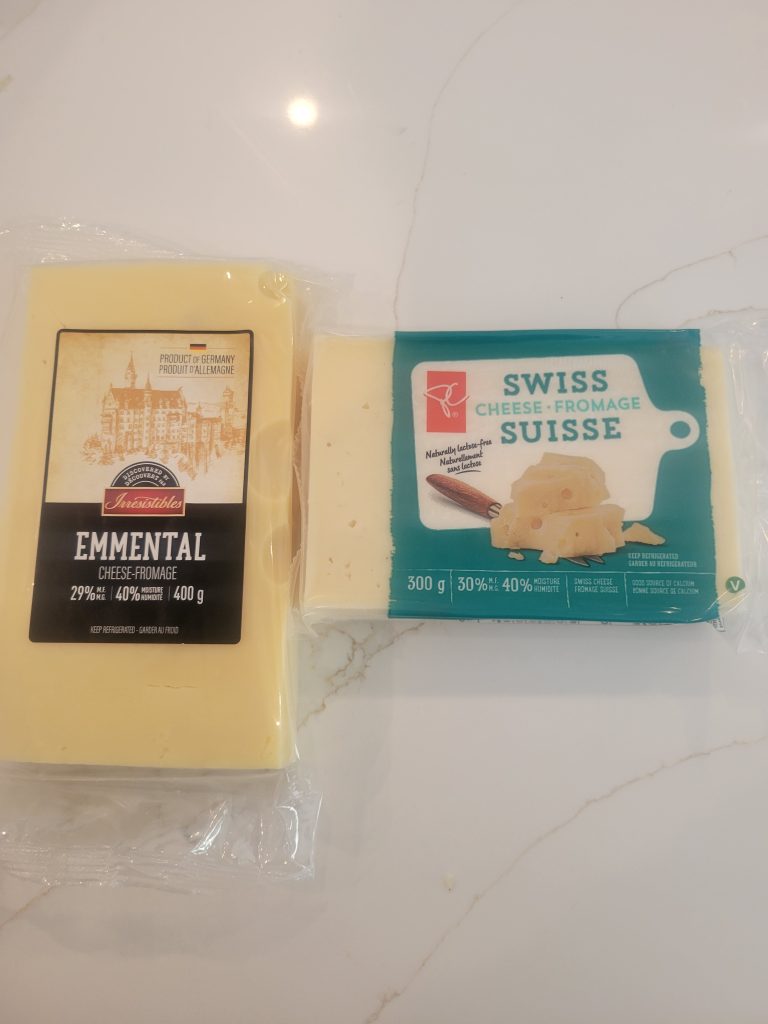
Two blocks of holey cheese. Same shelf. Same refrigerated aisle. One says “Emmental”, one says “Swiss” — and most North American shoppers assume they’re looking at two names of the same thing.
Here’s what’s actually going on. Emmental traces back to the 13th-century canton of Bern, making it Switzerland’s oldest known cheese variety.
“Swiss cheese” is a different thing entirely — or rather, it’s the absence of a thing. In Canada and the United States, the label refers to a domestic imitation of Emmental: a cheese that borrowed the visual identity, approximated the flavor, dropped the name, and replaced it.
The naming rights deserve precision here. “Emmentaler Switzerland” carries a protected designation of origin (AOP/PDO) — only cheese produced in the Emme Valley under traditional methods can carry that specific label. But “Emmental” on its own is not globally protected, meaning Germany, France, Finland, and others can legally produce and sell cheese under that name. The Irresistible Emmental I bought for this experiment at $2.75 CAD per 100g is made in Germany. It is not a knockoff. It is a legitimate Emmental-style cheese made outside the protected zone. The President’s Choice Swiss at $2.26 per 100g is something else entirely. It is named Swiss. It is not Swiss. It is a Canadian imitation of a German interpretation of a Swiss original.
The honest lineage runs three levels. At the top: Emmentaler AOP — raw milk, Emme Valley, fully protected, the original. Below it: German Emmental — same style, legitimate name, different geography. Below that: North American “Swiss” — a category label that tells you almost nothing. This experiment compares levels two and three, both from discount grocery stores, both tested blind.
The Experiment
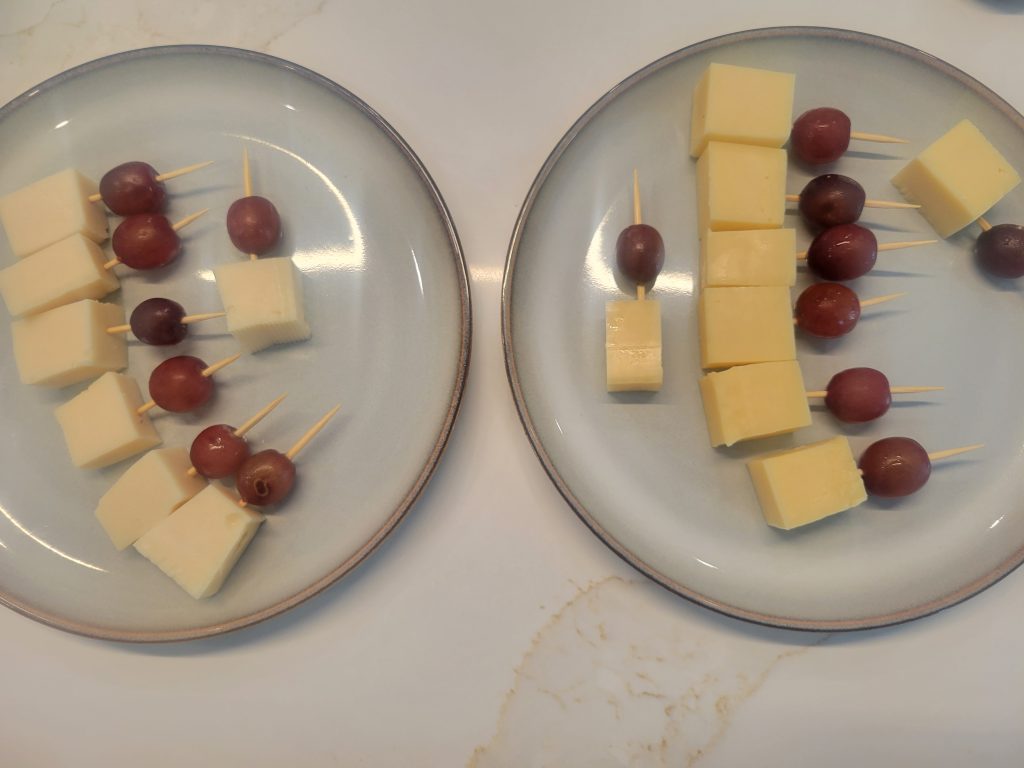
The vehicle was a grape skewer — cheese and fruit, nothing else. No crackers, no condiments, no interference. My mother, the blind taster across all Culinary Microscope experiments, received both cheeses cut to identical size with no identifying information. She tasted with her eyes closed throughout. No water between samples.
That last decision is deliberate. In a real charcuterie setting, you don’t get a neutral reset between bites. The contrast you experience is the experience. We wanted to replicate that.
The Findings
She didn’t need the second piece to make up her mind.
The Emmental reached her before it reached her mouth. The smell — at close range, eyes closed, no context — was enough to register something different, something that didn’t belong in the ordinary register of supermarket cheese. There was density to it, a kind of aromatic seriousness that signaled what was coming. Then it touched her lips, and before the taste had even developed, the texture alone carried information: this was a cheese that had been properly made and properly aged, the kind that asks for your attention before it delivers anything.
The taste confirmed everything the smell had promised. Pronounced, layered, unapologetically present. The kind of cheese that makes you pause.
The Swiss followed. Decent. Mild. The smell was neutral, the taste was acceptable, and neither did anything to distinguish itself or demand to be remembered. It wasn’t offensive — it simply had nothing to say.
One additional and more obvious observation recorded: the two cheeses look nothing alike. The Swiss is pale yellow. The Emmental is a deeper, richer yellow — visually consistent with higher fat content and more developed aging, and striking enough that it would stand out on any board before a single bite is taken. On a charcuterie spread, the gap between these two would be visible from across the table and confirmed with the first taste.
President’s Choice Swiss — 6.5 / 10
Acceptable. Inoffensive. Disappears into a board without embarrassing itself or contributing anything.
Irresistible Emmental, Germany — 8.5 / 10
A complete cold experience. The sensory arc — smell, then lips, then taste — builds and delivers at every stage. For $0.49 more per 100g, it is not a difficult decision.
The Verdict
The naming confusion in North American grocery stores has quietly buried one of the oldest cheeses in the world under a generic label, while putting its pale imitation at the same price point and trusting that nobody would notice the difference. Most people don’t — not because the difference is subtle, but because they’ve never been given the opportunity to taste both blind.
My mother tasted them blind. She noticed immediately, without hesitation, without a sip of water between samples. The Emmental won before she swallowed it.
Part 2 tests both cheeses in a heated application — where the structural differences between a properly made Emmental and a generic Swiss are likely to become even harder to ignore, or to the contrary unrecognizable?
This is part of Culinary Microscope — a blog dedicated to actually testing the ingredients and techniques that most food writing just opines about. Every claim here came from a real experiment in a real kitchen. When the results surprised me, I published them anyway.